Page Metadata
| Status: | ✅ Accepted |
|---|---|
| Date: | 2026-04-09 |
SolAr Does Not Handle OCI Registry Authentication
Context and Problem Statement
When evaluating how to implement authorization for OCI registries — ensuring every target has just enough permissions — we encountered significant complexity. The question of how SolAr should manage, distribute, and scope registry credentials across targets, environments, and security boundaries proved to be a deep architectural concern that risks coupling SolAr tightly to authentication infrastructure.
Team discussions converged on a simpler direction: SolAr should stay out of the authentication business entirely and instead require that targets declare their own registry access.
Decision Drivers
- Keeping SolAr decoupled from authentication infrastructure (different registries, different credential mechanisms, DMZ boundaries)
- Avoiding privilege escalation risks from SolAr distributing or copying registry credentials across namespaces
- Enabling SolAr to work in a variety of environments without prescribing a specific auth strategy
- Aligning with ADR-006 lessons around not copying secrets into tenant namespaces
Decision Outcome
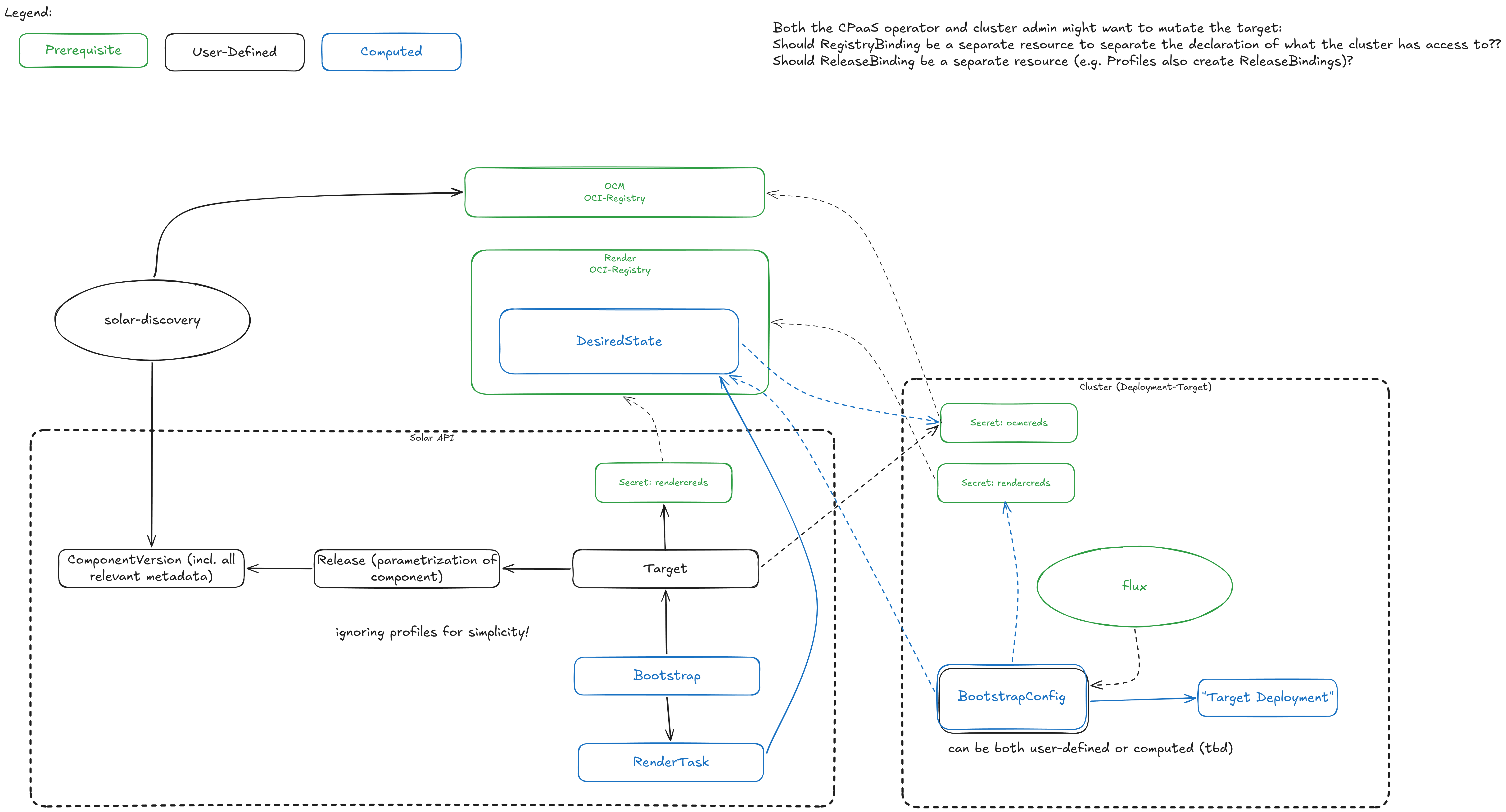
SolAr does not handle any OCI registry authentication. Instead, credentials and registry access information are provided by the entities that own them.
Design Principles
-
Components declare their origin. A Component/ComponentVersion clearly indicates which OCI registry it originates from. Registry aliases can be specified to handle environments where the same registry is reachable under different names (e.g. across a DMZ boundary).
-
Targets declare their registry access via RegistryBindings. A Target advertises which OCI registries it can access through dedicated
RegistryBindingresources. This includes the credentials for the destination registry where rendered desired state is pushed. See ADR-009 for the binding model. -
Rendering is per-target (optimize later). Each target gets its own rendered output, configured directly on the Target itself. This avoids premature optimization around shared renders. As a later optimization, targets that share the same registry access may be grouped for render deduplication — whether grouping by destination registry alone is sufficient or requires deeper access matching is an open question to be answered when the optimization is implemented.
-
Rendered output stays granular. The renderer produces multiple artifacts per target rather than a single monolithic one. This preserves the option for lazy rendering as a future optimization.
-
Registry access is validated at render time. When rendering for a target, SolAr checks that the target has access to all required registries. If a target cannot reach a required source registry, the render fails early with a clear error.
-
Discovery is fully optional. Catalog population via solar-discovery is not a prerequisite. Components and ComponentVersions can be created through other means (e.g. direct API calls, GitOps, catalog chaining).
Consequences
Positive:
- SolAr remains agnostic to the authentication mechanism (static credentials, workload identity, external secret operators, etc.)
- No credential copying or distribution logic in SolAr controllers
- Clear separation of concerns: the platform operator or cluster maintainer owns registry credentials
- Simpler security model — SolAr never holds credentials it does not need
Negative:
- Targets must be configured with registry access information, adding setup effort for the cluster maintainer
- SolAr cannot proactively verify registry connectivity — validation only happens at render time
- Registry alias configuration adds a concept that users need to understand in multi-environment setups