Page Metadata
| Status: | ✅ Accepted |
|---|---|
| Date: | 2026-04-09 |
Split Target Concerns into Registry, ReleaseBinding and RegistryBinding
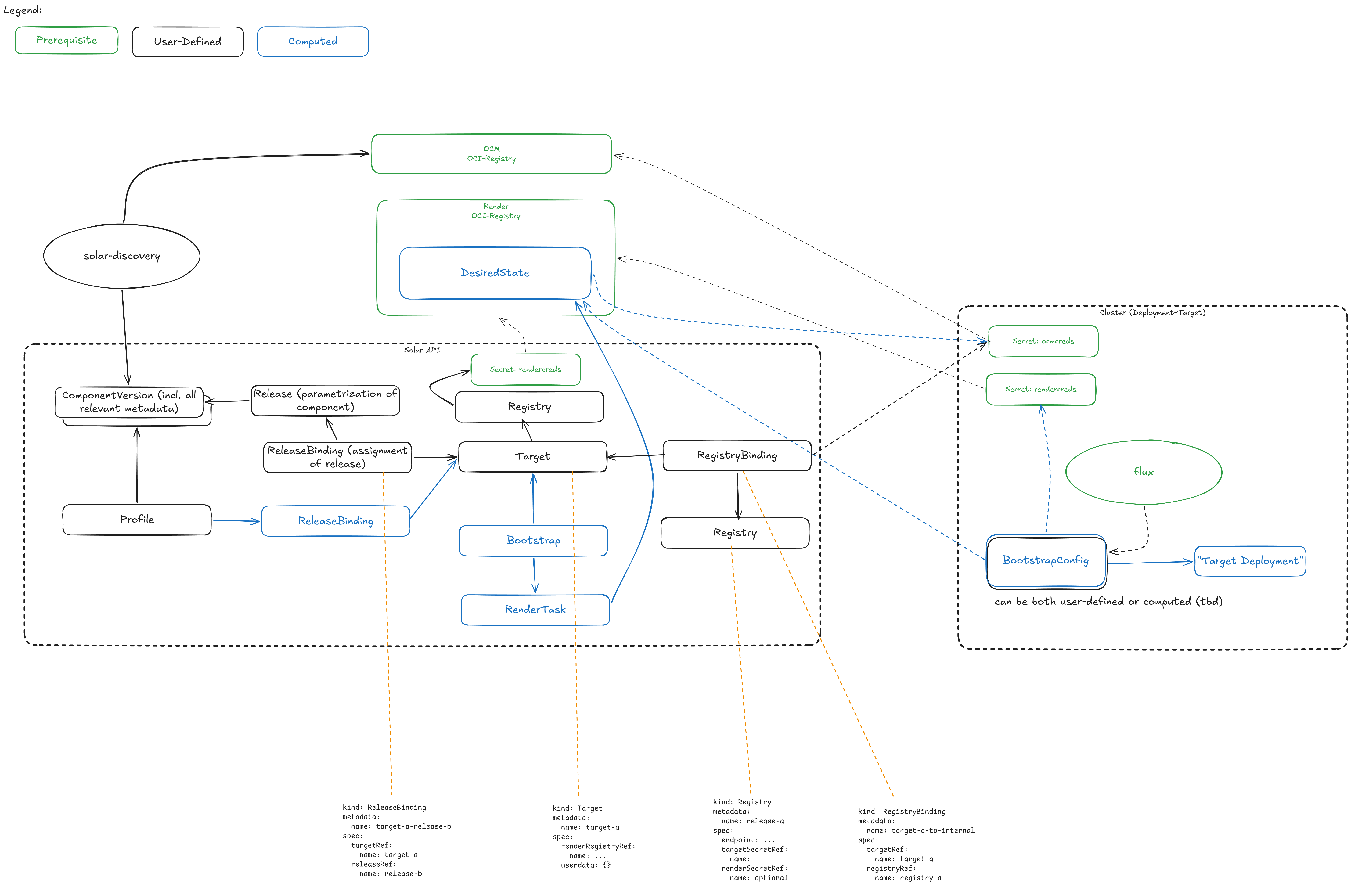
Context and Problem Statement
Today the Target resource conflates several concerns into a single object:
- Identity of the target cluster (registration, status reporting, agent configuration)
- Which registries the target has access to (and the credentials for them)
- Which Releases (or Profiles) should be deployed to it
This single-resource model makes it hard to express the reality of a multi-stakeholder environment. In practice, different user groups own different aspects of a target:
- Platform Provider owns part of the target's registry access and are responsible for part of the profiles and releases matching the cluster — they know which auxiliary registries the cluster can reach (DMZ, mirror, internal pull-through cache) and they control the credentials.
- Platform Provider owns the registration lifecycle of the target itself.
- Cluster Admins / Tenants own what is deployed onto the cluster — they pick releases and profiles from the catalog and assign them to targets.
- Cluster Admins / Tenants own the configuration of additional private registries.
Putting all of this on one object forces these groups to share write access to the same resource, which makes RBAC awkward and risks one group accidentally clobbering another's configuration. It also conflicts with ADR-008, which establishes that registry access and credentials should be declared by the entity that owns them rather than by SolAr or by the deployment coordinator.
Decision Drivers
- Enable distinct RBAC scopes for platform providers vs. tenants
- Align with ADR-008: credentials and registry access live with the entity that owns them
- Keep Target focused on cluster identity and agent lifecycle
- Allow multiple bindings to compose against the same Target without coordinated edits to a single object
- Support workflows where the platform provider provisions registry access ahead of time, before any tenant assigns workloads
Considered Options
- Keep Target monolithic — continue putting registry access and release assignments on Target itself.
- Split into Target + Registry + ReleaseBinding + RegistryBinding — four distinct CRs. A dedicated
Registryresource describes a registry once;RegistryBindinglinks a Target to a Registry;ReleaseBindinglinks a Target to a Release. - Split into Target + ReleaseBinding only — leave registry access on Target; only externalize release assignments.
- Split into Target + ReleaseBinding + RegistryBinding (no standalone Registry) — fold registry details into the RegistryBinding itself. Simpler, but duplicates registry metadata across bindings and makes it hard to share one registry definition across many Targets.
Decision Outcome
Chosen option: Option 2 — Split Target into four resources (Target, Registry, RegistryBinding, ReleaseBinding).
Resource Model
Target
The Target becomes a focused resource describing the cluster itself:
- Cluster identity and metadata (name, labels, security domain)
- Capacity information (CPU, memory, GPU, storage)
- Agent registration / status fields
- Render configuration (per ADR-008: how this target should be rendered for)
- A reference to a render Registry — the registry that the
RenderTaskfor this target will push its rendered desired state to (the "destination" for this target's rendered output)
The Target no longer carries registry credentials or release assignments directly. The render registry reference is the one registry linkage that remains on Target, because the render destination is an intrinsic property of the target's lifecycle (it defines where the target's agent pulls from) rather than a tenant-driven binding.
Registry
A Registry is a first-class resource that describes an OCI registry once, independent of any Target. Owned by the CPaaS/Platform Provider (primarily) or by Cluster Maintainers for tenant-private registries.
Conceptually:
- Registry endpoint / URL and any aliases that apply in specific environments (see ADR-008)
- Registry kind / capability hints (e.g. source, destination-capable, mirror, pull-through cache)
- Reference to the credentials secret(s) used to access it
- Optional TLS / CA configuration, pull-through behavior, etc.
Pulling registry details out of the bindings means a single registry definition can be shared across many Targets without duplicating endpoint or credential configuration. It also gives platform providers a single place to rotate credentials or update endpoints.
RegistryBinding
A RegistryBinding declares that a specific Target is allowed to use a specific Registry, and in which role. It is a pure link resource — it holds no registry configuration of its own. Owned by the CPaaS/Platform Provider or Cluster Maintainer.
Conceptually:
- References a Target
- References a Registry
- Indicates direction / role: source (pull desired state, pull components) or destination (push rendered output)
- Optional binding-scoped overrides (e.g. a tenant-provided pull secret override, scoping hints)
Multiple RegistryBindings can apply to the same Target, one per registry the target should be allowed to use. The same Registry can be bound to many Targets via independent RegistryBindings.
ReleaseBinding
A ReleaseBinding declares that a Release (or Profile) should be deployed to a Target. Owned by the Deployment Coordinator / Tenant.
Conceptually:
- References a Target
- References a Release or Profile
- Carries any binding-specific overrides or scheduling constraints
Multiple ReleaseBindings can apply to the same Target, one per workload the tenant wants to deploy.
Impact on Profiles and Bootstrap (formerly HydratedTarget)
The way Profiles work will change as part of this split. Rather than being directly referenced from a Bootstrap (previously HydratedTarget) construct, Profile-related controllers will materialize their effect by creating ReleaseBindings for the targeted clusters. The Profile becomes a higher-level grouping/templating concept whose reconciliation output is a set of ReleaseBindings.
A consequence of this is that the Bootstrap resource (previously HydratedTarget) most likely becomes obsolete. Its role — capturing the effective desired state for a target derived from one or more Profiles — is now expressed declaratively as the set of ReleaseBindings that point at the Target, combined with the Target's own render Registry reference. This removes one layer of indirection and aligns the model with the new ownership boundaries.
The exact migration path for existing Bootstrap consumers is left to a follow-up.
Interaction with Rendering
When the renderer produces output for a Target, it:
- Collects all
ReleaseBindings pointing at that Target to determine the desired state. - Collects all
RegistryBindings pointing at that Target, resolves each to its referencedRegistry, and builds the set of reachable registries and credentials. - Validates (per ADR-008) that all source registries required by the bound Releases are covered by a RegistryBinding that resolves to a compatible Registry.
- Resolves the Target's render Registry reference and uses it as the destination for the
RenderTask's push of the rendered desired state.
If a required source registry has no matching RegistryBinding, or if the Target's render Registry reference cannot be resolved, rendering fails with a clear error pointing at the missing resource.
RBAC Model
The split enables clean role separation:
| Resource | Typical Owner |
|---|---|
| Target | Cluster Maintainer |
| Registry | CPaaS/Platform Provider (primarily), Cluster Maintainer for tenant-private registries |
| RegistryBinding | CPaaS/Platform Provider, Cluster Maintainer |
| ReleaseBinding | Deployment Coordinator (Tenant) |
Each group can be granted write access to only the resource type they own, without exposing the others.
Consequences
Positive:
- Clear ownership boundaries — each stakeholder writes their own resources
- RBAC becomes straightforward: standard Kubernetes Role/RoleBinding per resource type
- Platform providers can provision registry access ahead of tenant onboarding
- Tenants can assign releases without touching credential or registry configuration
- Aligns naturally with ADR-008: SolAr never holds credentials it does not need
- Composable — adding a new release or new registry no longer requires editing the Target
- A single
Registrydefinition can be reused across many Targets; endpoint or credential rotation happens in one place - The Bootstrap resource (formerly HydratedTarget) is expected to become obsolete, removing a layer of indirection
Negative:
- Four resource types to manage instead of one; users see more objects in
kubectl get - The relationship between Target, Registry, RegistryBinding, and ReleaseBinding must be discoverable (likely via labels/selectors or owner references) — UI and CLI tooling needs to surface this
- Migration path needed for existing Target objects that currently embed registry access and release assignments
- More controller logic to validate bindings consistently and to resolve Registry references
- The Target's render Registry reference creates a direct dependency between Target and Registry that must be validated on Target admission
Naming
The *Binding suffix was chosen to match Kubernetes conventions (RoleBinding, ClusterRoleBinding) and to clearly signal "this resource links X to Y". Alternative names were considered and should be discussed by the team before finalizing:
| Concept | Proposed | Alternatives |
|---|---|---|
| Registry definition | Registry |
OCIRegistry, ContainerRegistry, RegistrySource |
| Registry access for a Target | RegistryBinding |
TargetRegistry, RegistryAccess, RegistryGrant, TargetRegistryAccess |
| Release assignment to a Target | ReleaseBinding |
TargetRelease, ReleaseAssignment, Deployment, TargetReleaseAssignment |
Trade-offs:
*Binding— matches K8s RBAC patterns, neutral; risk of being conflated with RoleBindings in conversation.Target*— emphasizes the Target as the primary axis; reads naturally inkubectllistings (kubectl get targetregistries); risk of being mistaken for sub-resources of Target.*Access/*Grant— emphasizes the authorization aspect (good fit for RegistryBinding given ADR-008), but a less natural fit for releases.*Assignment— verbose but explicit;Deploymentis too overloaded (clashes withapps/v1.Deployment).
The team should pick one consistent suffix across both resources rather than mixing styles.
Open Questions
- Should bindings live in the same namespace as the Target, or can they be cross-namespace (e.g. a platform-provider namespace holding RegistryBindings that target tenant Targets)? This interacts with ADR-005 (cluster-scoped resources) and the ReferenceGrant spike.
- Should
Registrybe cluster-scoped (shared catalog of registries) or namespaced (per-tenant registries)? A mixed model may be needed. - Does the Target's render Registry have to be covered by a matching destination-role RegistryBinding, or is the Target reference itself sufficient authorization to push? (Leaning toward: the reference is sufficient, since it is set by the Target owner.)
- How are status conditions surfaced — on the binding, on the Target, or both?
Deferred
- Selector-based bindings — whether a
TargetGroupor label-selector mechanism should let one binding apply to many Targets. Deferred: we want a simple working solution first; this is an optimization to revisit once the basic model is in use.